
Cd Cover Template
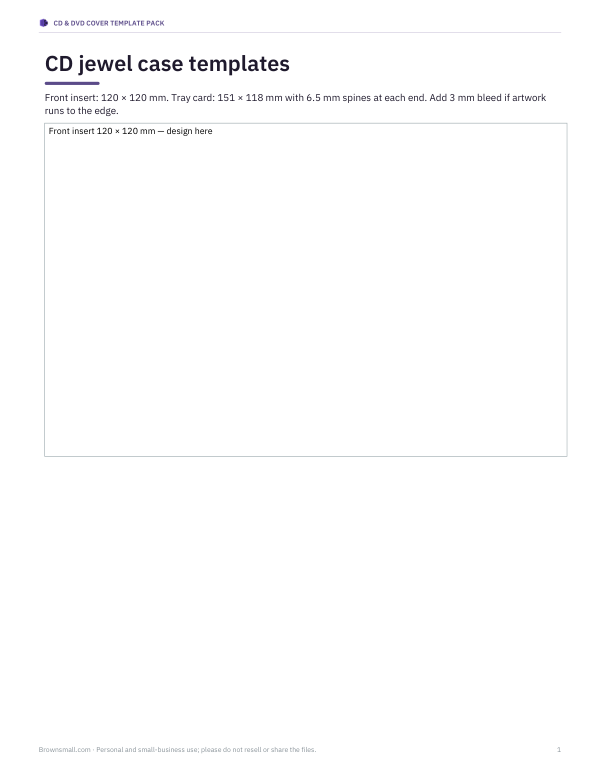
Design a CD cover without setting up page sizes by hand. Enter the album title, artist and track list, add a cover image from your computer, and print a front insert (120 × 120 mm) and back tray card (151 × 118 mm with spines) with cut lines, ready to trim and slide into a standard jewel case.
- Free to use
- No sign-up
- Runs in your browser
Make a CD cover
CD & DVD Cover Template Pack
Exact-size Word and PDF templates for jewel case inserts, tray cards, 4-page booklets, slim cases, DVD wraps and CD labels, with cut and fold guides.
- Jewel case insert & tray card (DOCX, PDF)
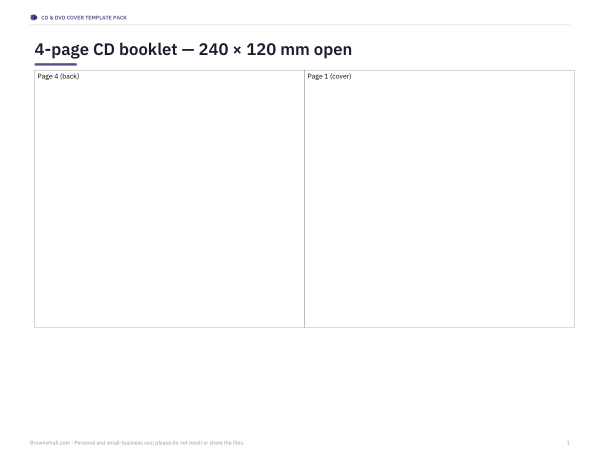
- 4-page booklet (DOCX, PDF)
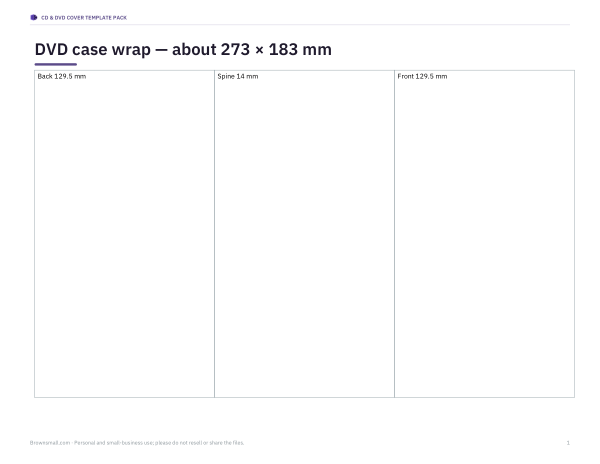
- DVD case wrap (DOCX, PDF)
- Sizes reference (PDF, XLSX)
Formats: DOCX, PDF, XLSX. Instant download after payment (link valid 72 hours, up to 5 downloads). AI-assisted: the templates were drafted with AI help and reviewed and laid out before publishing.
$4.00 USD, one-time 4 files · about $1.00 each
- Instant download
- 7-day refund
- Secure checkout by Stripe
7-day money-back guarantee. Full refund within 7 days of purchase, even after you download.
Free sample: CD Booklet 4 Page (PDF, 57 KB)
Full refund within 7 days — see the refund policy and license.
Free printables
Single sheets you can print right now, no sign-up. The full pack adds every sheet in one download plus the editable files.
 CD Cover Sizes Reference
CD cover sizes
| Part | Size | Notes |
|---|---|---|
| Front insert (booklet cover) | 120 × 120 mm (4.72 × 4.72 in) | Sits under the clips in the lid; a folded booklet is 240 × 120 mm open |
| Back tray card (inlay) | 151 × 118 mm (5.94 × 4.65 in) | Includes two 6.5 mm spines folded at each end; the main back panel is about 138 mm wide |
| CD label (disc face) | 118 mm outer, 15–41 mm centre hole area | Use adhesive labels designed for CDs, or printable discs |
| Slim case insert | 120 × 120 mm front only | Slim cases have no tray card or spines |
| Paper sleeve | 125 × 125 mm pocket | Window sleeves show the disc face |
Jewel case sizes are an industry convention; minor variations exist between manufacturers, so measure your cases if the fit is tight. Printers recommend a 3 mm bleed beyond the trim line if artwork runs to the edge.
How to use the CD cover maker
- Enter the album title, artist and track list, one track per line (durations are optional).
- Choose background and text colours, and add a cover image if you have one — it stays on your computer.
- Check the preview, then click Print and set scale to 100% or “Actual size”.
- Print on matte or glossy photo paper around 120–200 gsm; heavier card will not fit under the tray.
- Cut along the solid lines with a craft knife and ruler.
- Fold the tray card along the dashed spine lines and slide it behind the clear tray; place the front insert in the lid.
If your printer adds margins that shrink the page, look for a “borderless” or “Actual size” setting.
Design tips for a CD cover
- Keep the title and artist readable at thumbnail size — many people will see the cover small on a screen.
- Leave about 3 mm around the edges clear of text, since trimming is rarely perfect.
- Use high-resolution images: 300 pixels per inch means about 1,420 × 1,420 pixels for the 120 mm front.
- Check contrast between text and background, especially over photos.
- Put the artist and title on the spines so the case can be found on a shelf.
- On the back, list tracks with numbers; include total running time, label, year and copyright notices if you distribute the CD.
Home printing vs professional printing
Home printing works well for mixtapes, demos, gifts, wedding favours and small runs. For larger runs to sell at gigs or online, professional replication or duplication companies print full-colour inserts on coated stock and assemble the cases. They supply their own templates with bleed and safe zones; use your design as the basis and export at their specifications, typically CMYK at 300 dpi with bleed.
Copyright and artwork
Use artwork you created, own or have permission to use. Photos found online are usually protected by copyright. If you are distributing music, credit songwriters and performers, and check that you have the rights to any covers you recorded — in many countries a mechanical licence is needed to distribute recordings of songs written by others.
Worked example
For a five-track demo, the band enters “Summer Sessions” by “The Harbour Lights”, picks a deep navy background with off-white text, and adds a photo of the harbour. The front insert shows the photo with the title and band name at the bottom. The tray card lists the tracks with durations and “2026 · Home Recordings”, and both spines read “The Harbour Lights — Summer Sessions”. They print on 160 gsm matte photo paper at actual size, trim with a craft knife, and fold the spines before sliding the card behind the tray.
Track list and credits
A clear back cover lists tracks in order with numbers and, optionally, running times, followed by the total length. Below the list, add the artist, recording and mixing credits, the label or “self-released”, the year, and copyright lines such as “© 2026 The Harbour Lights” for the artwork and “℗ 2026” for the sound recording. If there are many credits, move them into the booklet and keep the tray card uncluttered. Check spelling carefully — reprinting a run of inserts because of a typo is a common and expensive mistake.
Other disc packaging
| Package | What to print |
|---|---|
| Standard jewel case | Front insert + tray card with spines |
| Slim jewel case | Front insert only |
| DVD case | Wraparound cover about 273 × 183 mm including a 14 mm spine |
| Card wallet / digipak | Supplier-specific die-cut template |
| Paper or plastic sleeve | Disc label only, or a small insert |
Privacy
Everything happens in your browser. Your cover image is loaded locally for the preview and printing; it is not uploaded, and it disappears when you close the page.
Frequently asked questions
What size is a CD cover?
The front insert is 120 × 120 mm (4.72 in square).
What size is a CD back cover?
The tray card is 151 × 118 mm including two 6.5 mm spines.
What paper should I use?
Photo or presentation paper around 120–200 gsm.
Why is my printed cover the wrong size?
The printer scaled it; set scale to 100% or Actual size.
Is my cover image uploaded?
No. It stays in your browser.
Can I make a CD booklet?
The paid pack includes a 4-panel booklet template; the online tool makes a single front insert.
Can I print a cover for a slim case?
Yes. Print only the front insert; slim cases have no tray card or spines.